doc-extract-pipeline — Self-Checking Invoice Extraction
Tech Stack Versions
Precise technology versions used in this project
Screenshots
Main feature screens of the project
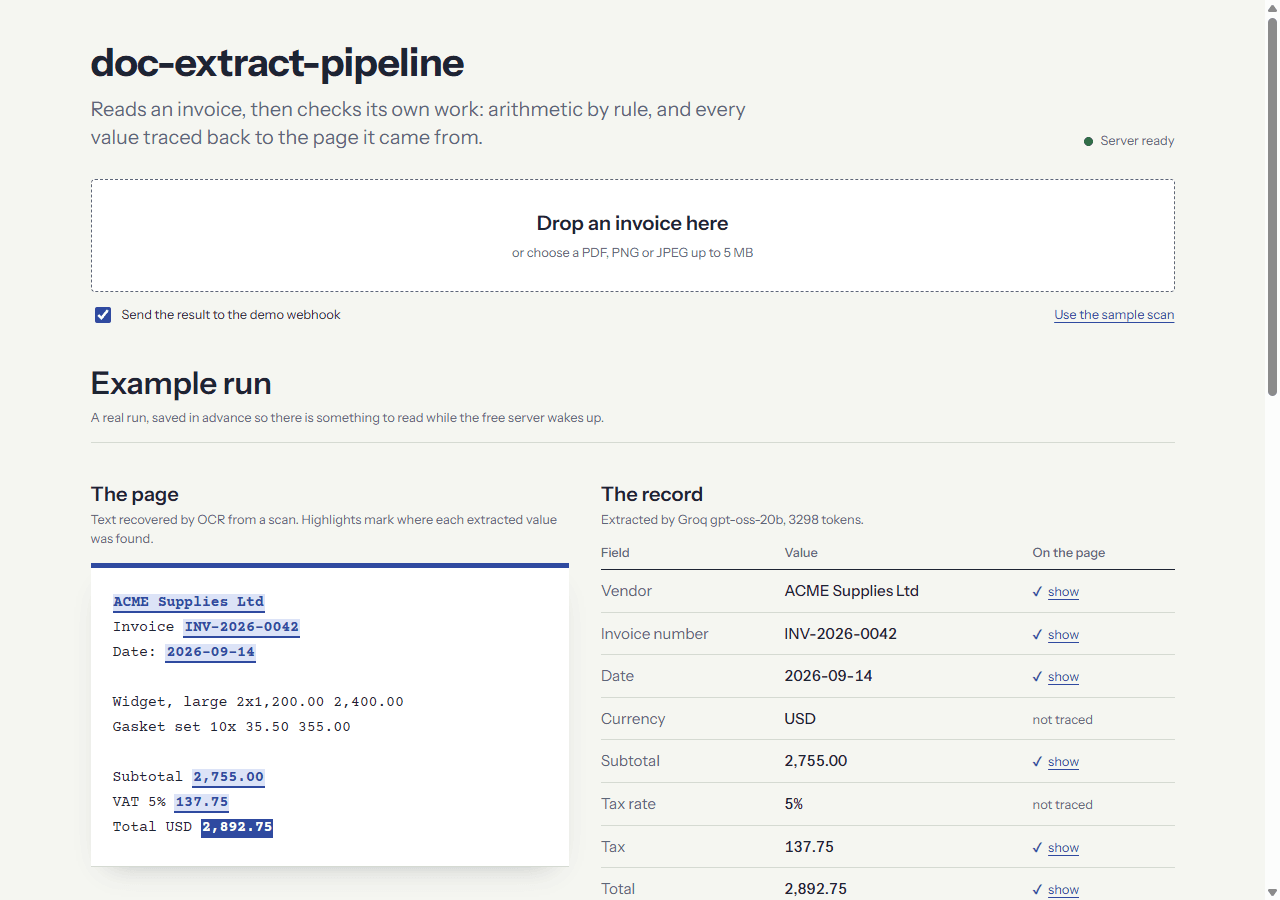
Extraction result — every value highlighted where it was found on the OCR text
A full run — one check failed, the model retried with that feedback, then a signed webhook was delivered
Capabilities Demonstrated
Technical and business capabilities demonstrated through this project
- Extracts invoice data and verifies it before anyone relies on it
- Reads both digital PDFs and scanned images
- Keeps working through server restarts without losing documents
- Delivers results to your systems by signed webhook
- Safe to expose publicly, with abuse and cost limits built in
Challenges Faced
Main technical challenges encountered during development
- LLM output is sometimes confidently wrong, and a model-based checker would exceed the 8K tokens-per-minute free limit.
- Deploys SIGTERM the process group, killing OCR mid-page and marking documents as failed.
- The free broker has no persistence, and a silent broker hung uploads for 30–90 seconds.
- A public demo accepts attacker input: forged client IPs, webhook URLs aimed at the private network, and pixel-bomb images.
- Render's free plan has no worker service and no memory metrics.
Solutions
Technical solutions and implementation strategies adopted
- Eight plain-Python rules plus grounding, with failed rules fed back through a bounded LangGraph cycle.
- Interrupted runs hand the document back to the queue under the same attempt ceiling as an expired lease.
- MongoDB as the source of truth with a lease and sweeper; broker publish capped at 2 seconds.
- Trust only Cloudflare-owned IP headers, pin webhook connections to the validated IP, and check limits from headers before spending quota.
- One container under honcho with a Celery solo pool and lazy imports; memory measured locally from cgroup memory.peak.
Code Snippets
Key implementation code from the project
def build_graph(pipeline: Pipeline) -> Any:
    builder = StateGraph(GraphState)

    builder.add_node("ingest", pipeline.ingest)
    builder.add_node("classify", pipeline.classify)
    builder.add_node("extract", pipeline.extract)
    builder.add_node("validate", pipeline.validate)

    builder.add_edge(START, "ingest")
    builder.add_edge("ingest", "classify")
    builder.add_edge("classify", "extract")
    builder.add_edge("extract", "validate")
    builder.add_conditional_edges(
        "validate",
        route_after_validate,
        {"retry": "extract", "done": END},
    )

return builder.compile()Architecture Decisions
Key architectural and technical decisions made during development
Context
Extraction needs checking on a free tier of 8,000 tokens per minute.
Options Compared
- Can catch semantic mistakes without writing a rule for each
- Worst path ~9,900 tokens — over Groq's 8,000 tokens-per-minute free limit
- A model checking its own arithmetic is still unreliable
- sum(lines) + tax == total is decidable — zero tokens, milliseconds
- Each failed rule becomes specific feedback for the retry
- Grounding proves a value was copied, not that it went into the right field
Decision
Deterministic rules, with failures fed back for a bounded retry.
Outcome
11/11 golden invoices pass validation; 109/110 fields correct.
Technical Highlights
In-depth technical implementation details and architecture design
Deterministic validation with source grounding
- Eight plain-Python rules check LLM output, including grounding every value in the source text; failures feed back through a bounded LangGraph retry cycle instead of a second model call.
Broker-independent recovery
- MongoDB is the source of truth; an atomic lease and a sweeper recover lost messages, duplicate deliveries and interrupted runs, verified on the live host.
Hardened public LLM demo
- Webhook SSRF guard pinned to the validated IP, quotas keyed on Cloudflare-owned client-IP headers, and page/pixel caps checked before any quota is spent.
Engineered to measured free-tier limits
- API and Celery worker share one 512 MB container under honcho; peak memory 339 MB, median 1,838 tokens per invoice, ~20 s per scanned page.
Key Takeaways
Important lessons and reflections from this project
Grounding proves a value was copied, not that it went to the right field.
Real Impact: The one golden-set miss was a mislabelled total; rule checks need a field-position cue for that case.
Put state where it survives and send only ids through the queue.
Real Impact: Lost messages, duplicates and restarts became one event: an expired or refused lease.
Only running on the real host finds the silent failures.
Real Impact: Three of four reliability scenarios found bugs no unit test had.
Interested in this project?
Feel free to reach out to discuss similar technical solutions or how I can help with your project.
Contact Me