AI Support Agent — Multi-Tenant AI Customer Support SaaS
Tech Stack Versions
Precise technology versions used in this project
Screenshots
Main feature screens of the project
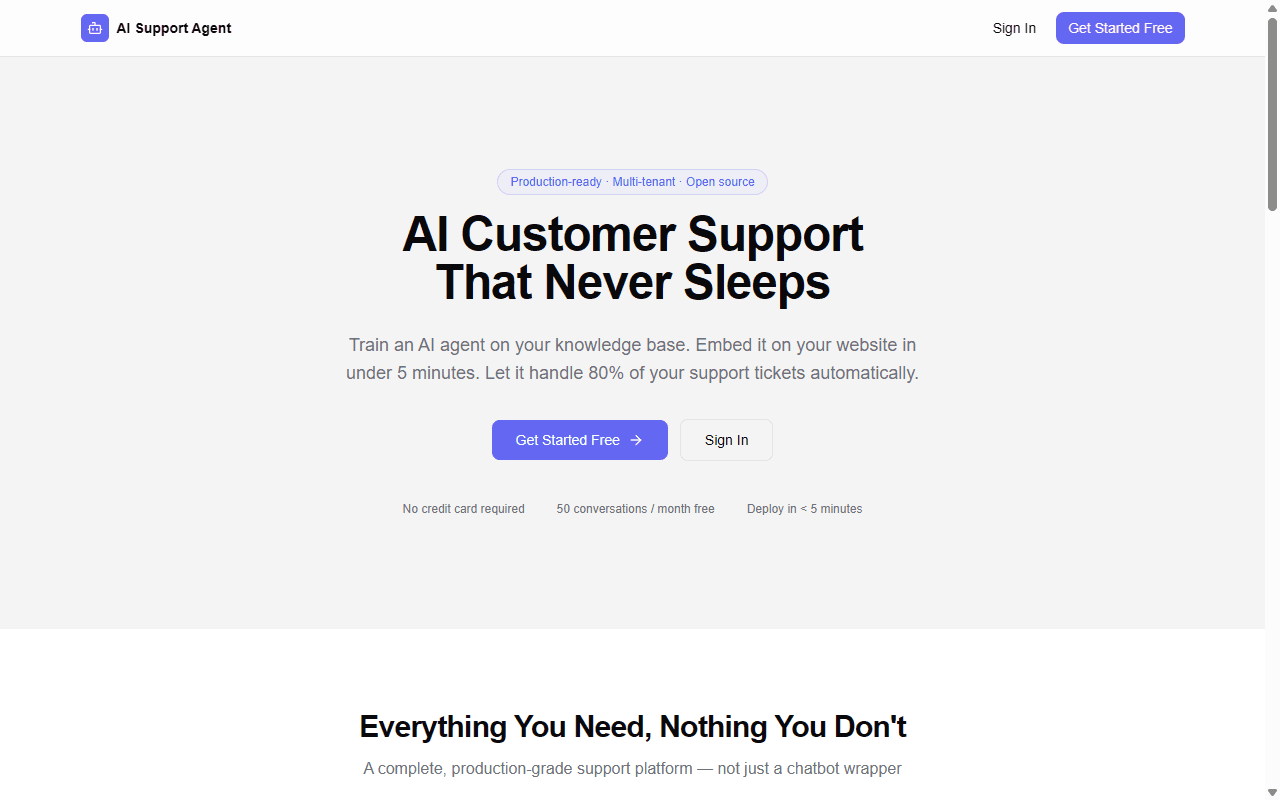
Landing Page — Feature showcase, pricing tiers, and live AI demo
Dashboard Overview — Real-time metrics, conversation volume, and tool usage stats
Analytics — Multi-dimensional charts, AI response efficiency, and ticket trends
Conversation List — Multi-tenant conversation management with status filtering and search
Conversation Detail — AI tool call traces, message streaming, and Widget preview
Product Management — Inventory tracking, pricing, and AI-queryable product data
Order Management — Order status tracking with AI-automated lookup integration
Ticket System — AI-automated ticket creation, agent tracking, and status management
Knowledge Base — RAG document upload, vector indexing, and search testing
Embeddable Widget — Cross-site deployment, API key authentication, and live AI chat
Capabilities Demonstrated
Technical and business capabilities demonstrated through this project
- Autonomous AI Agent — 4-tool ToolLoopAgent handles order lookups, inventory checks, knowledge search, and ticket creation without human intervention
- Semantic Knowledge Retrieval — RAG pipeline with Google Gemini embeddings and pgvector cosine similarity delivers sub-second answers from uploaded documents
- Multi-Tenant Data Isolation — Organization-scoped queries with TOCTOU-safe mutations ensure complete data separation across tenants
- Defense-in-Depth Security — SHA-256 API key hashing, 3-layer prompt injection sandwich, sliding window rate limiting, and timing-safe authentication
- Stripe Subscription Billing — Checkout + webhook integration with plan-based feature gating controlling AI tool access per tier
Challenges Faced
Main technical challenges encountered during development
- Prisma + Edge Runtime compatibility — static imports crash Turbopack workers in Next.js edge environments
- Multi-tenant data isolation under TOCTOU race conditions — find-then-mutate patterns create cross-tenant vulnerabilities
- AI prompt injection prevention — organization-customizable system prompts create attack vectors for security rule bypass
- Plan-based feature gating without per-request performance penalty — checking plan limits on every AI tool call adds latency
- Widget API key security in multi-tenant context — storing raw keys means database breach exposes all widget credentials
Solutions
Technical solutions and implementation strategies adopted
- Singleton factory pattern in db.ts using @prisma/adapter-neon with lazy initialization via globalForPrisma, ensuring edge compatibility without static import crashes
- Atomic updateMany/deleteMany with orgId in WHERE clause collapses check+mutation into single round-trip; session ownership verified before cross-session writes
- 3-layer prompt construction: base behavior → org custom (sandwiched) → security rules ALWAYS last; validateAndSanitizeMessages strips role:system from client input
- Tool gating applied at agent construction time — createSupportAgent reads plan limits once, filters tools via Set, zero per-request overhead
- SHA-256 hashed API keys at creation; widget auth uses hash lookup with raw key fallback; crypto.randomBytes(32) provides 256-bit entropy
Code Snippets
Key implementation code from the project
// src/lib/ai/agent.ts
export function createSupportAgent(
  orgId: string,
  plan = "free",
  customSystemPrompt?: string | null
) {
  const limits = getPlanLimits(plan);
  const allowed = new Set(limits.enabledTools);

  const allTools = {
    searchKnowledgeBase: createSearchKnowledgeBaseTool(orgId),
    getOrderStatus: createGetOrderStatusTool(orgId),
    checkInventory: createCheckInventoryTool(orgId),
    createTicket: createCreateTicketTool(orgId),
  };

  // Plan-based tool gating — filter tools by plan limits
  const tools = Object.fromEntries(
    Object.entries(allTools).filter(([key]) => allowed.has(key))
  ) as typeof allTools;

  return new ToolLoopAgent({
    model: getModel(),
    instructions: buildSystemPrompt(customSystemPrompt),
    tools,
    stopWhen: stepCountIs(10),
  });
}Architecture Decisions
Key architectural and technical decisions made during development
Context
AI Support Agent requires multi-round tool calls (KB search → order lookup → ticket creation), choosing between a custom tool loop and an SDK.
Options Compared
- Full flow control with precise customization at each step
- Must implement tool call parsing, result injection, multi-round loop, and stop conditions
- Error handling and edge cases must be handled manually
- ToolLoopAgent has built-in multi-round loop, stopWhen step control, and tool result injection
- toDataStreamResponse() provides unified stream format shared by Dashboard and Widget
- Framework dependency; upgrades may introduce breaking changes
Decision
Chose Vercel AI SDK v6: standardized agent framework reduces 300+ lines of boilerplate; stopWhen makes plan-based step limits one-liner; toDataStreamResponse enables Dashboard/Widget to share one Stream Factory
Outcome
Agent core logic compressed to 30 lines; Dashboard and Widget share createChatStream; plan gating configured in one maxSteps line
Technical Highlights
In-depth technical implementation details and architecture design
ToolLoopAgent + 4 Tools + Plan-Based Gating
- Vercel AI SDK v6 streamText — multi-round tool calls until resolution
- stopWhen(stepCountIs(n)) — Free 3 steps / Pro 10 steps, one-line plan gating
- Dynamic tool assembly — order / inventory / ticket tools injected only for Pro plan
Gemini Embeddings → pgvector Cosine Search → Org-Scoped
- text-embedding-004 (768 dims) — Google Generative AI text embeddings
- pgvector <=> cosine distance operator + raw query (Prisma doesn't natively support)
- Knowledge base fully isolated per org, search results enforced with orgId filter
Organization Model + API Key + Data Isolation
- 17 Prisma models — Organization, User, Product, Order, Ticket, ChatSession, Embedding, and more
- Every Prisma query enforced with orgId — TOCTOU-safe updateMany / deleteMany
- Free / Pro plan driven by Prisma model, feature gating without hardcoded logic
Prompt Injection Sandwich + SHA256 + Rate Limiting
- Prompt Injection Sandwich — three-layer system prompt with Security Rules fixed last
- SHA256 API key hashing — raw key displayed once, plaintext never stored again
- Rate limiting (in-memory) + CSP / HSTS / X-Frame-Options HTTP security headers
Key Takeaways
Important lessons and reflections from this project
Co-locate vector data with relational data — pgvector on Neon PostgreSQL eliminates an entire service dependency while maintaining sub-second search. For knowledge bases under 100K chunks per tenant, a co-located extension outperforms a separate vector DB in both latency and operational simplicity.
Real Impact: Zero additional infrastructure, tenant-scoped embeddings via orgId index, queries join Embedding to Document with status filter — all in one database.
Gate features at construction, not execution — filtering tools at agent creation time via Set gives zero per-request overhead. The agent literally cannot call tools it does not have. This pattern applies broadly: restrict capabilities at initialization rather than guarding every invocation.
Real Impact: Clean agent factory in ~30 lines, plan gating adds zero runtime overhead, MockLanguageModelV3 enables full demo without API keys.
Security rules as the final prompt section — allowing org-customizable system prompts creates a prompt injection vector. The 3-layer sandwich (base → custom → security) ensures no custom prompt can bypass safety constraints. This should be standard for any LLM app accepting user-configured instructions.
Real Impact: Multi-layered defense with all security tests failing to breach boundaries; org data protected by dual defense at prompt and database layers.
Interested in this project?
Feel free to reach out to discuss similar technical solutions or how I can help with your project.
Contact Me